The Sky Is Getting Wetter. The Ground Isn’t.
Somewhere in North Bengaluru, a quiet heist is underway. Every day, a system of liquid desiccants; essentially very thirsty salts inhales moisture from the air and exhales purified drinking water. The perpetrator: Uravu Labs.The victim: the atmosphere. The crime: stealing water from thin air. Literally.[1]
Before the sky files a restraining order, it's worth examining whether this atmospheric pickpocketing actually matters or whether the atmosphere is so absurdly wealthy in water that it won't even notice the missing change from its coat pocket.
Uravu Labs currently produces around 4,000 litres of water per day from its flagship plant in Bengaluru, with ambitions to scale to 100,000 litres per day in the coming years. The technology works by exposing a liquid desiccant, typically a concentrated salt solution like calcium chloride, to ambient air. The desiccant hungrily absorbs water vapour (much like silica gel packets absorb the will to live from new shoe boxes). Heat is then applied, often from renewable sources, to release the captured moisture as steam, which is condensed and mineralised into drinking water.[2][3][4][5][1]
This is elegant chemistry. But 4,000 litres a day sounds like a lot of atmospheric water to just... take. So let's put it in context.
The Earth's atmosphere holds approximately 12,900 cubic kilometres of water vapour at any given moment. That's 12,900,000,000,000,000 litres (roughly twelve-point-nine quadrillion litres), a number so large it loses all meaning, like measuring the universe in millimetres.[6][7]
To translate: if every drop of atmospheric moisture were to simultaneously condense and fall, it would blanket the entire planet in a uniform layer of water about 2.5 centimetres deep. Enough to ruin everyone's socks, but not quite enough for a swimming pool.[6]
Now, Uravu's 4,000 litres per day represents approximately 0.000000000000031% of that atmospheric reservoir. Even at 100,000 litres per day, the proportion nudges to about 0.00000000000077%. To offer ananalogy: this is roughly equivalent to a mosquito deciding to take a sip from the Pacific Ocean, feeling guilty about it, and writing an apology letter to Poseidon.
Here's where the story becomes even less dramatic for the atmosphere. Water vapour doesn't just sit in the sky like money in a savings account. It constantly cycles.
The global mean residence time of a water molecule in the atmosphere is approximately 8 to 10 days. That means the entire atmospheric water reservoir is effectively emptied and refilled roughly 40 times per year through evaporation and precipitation. The total annual throughput of water cycling through the atmosphere is approximately 495,000 cubic kilometres, nearly 40 times the standing stock.[8][9][6]
In other words, the atmosphere is a river. A fantastically fast-moving, planet-spanning river of vapour that replenishes itself with the urgency of someone who just remembered they left the tap running, except in this case, the tap is every ocean, lake, river, and moist patch of soil on Earth.
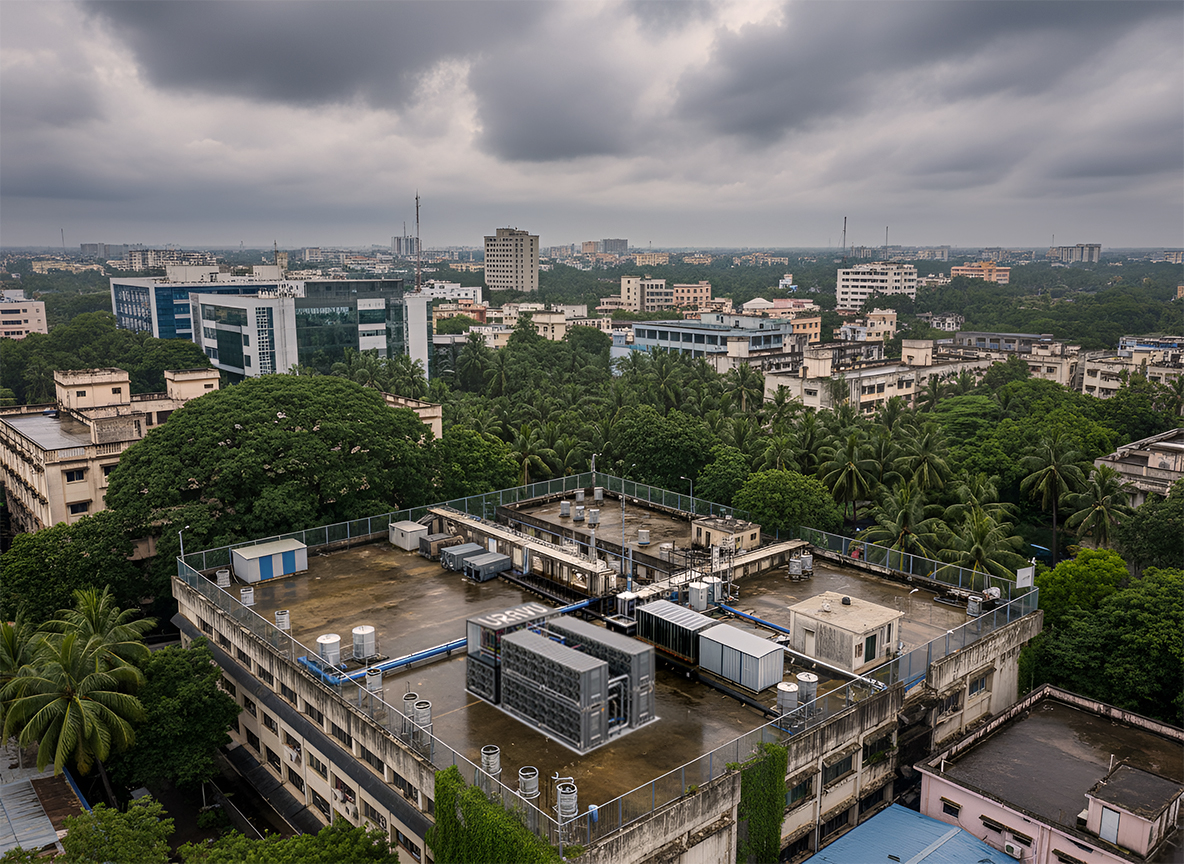
Uravu's extraction of 4,000 litres per day is the atmospheric equivalent of dipping a teaspoon into a river flowing at 1.35 trillion litres per day (the daily global evaporation flux). The river, respectfully, does not care.
A fair scientist would ask: even if the global impact is negligible, could local extraction create a dry pocket; a miniature atmospheric drought around the plant?
The short answer: no, and the physics are reassuringly dull.
Atmospheric mixing is extraordinarily efficient. Wind, convection, and turbulent diffusion constantly redistribute moisture across enormous volumes of air. Water vapour constitutes roughly 0.4% to 2% of the atmosphere by volume, varying with temperature and geography. In a city like Bengaluru, where humidity levels routinely hover between 50% and 80%,the volume of moisture passing over any given square kilometre in a single hour dwarfs Uravu's entire daily output by several orders of magnitude.[10][11]
Even industrial-scale atmospheric water generation systems producing tens of thousands of litres per day would extract a quantity of moisture that is replaced by atmospheric circulation within minutes. Unlike groundwater, which replenishes over geological timescales, atmospheric moisture operates on what might generously be called "impatient" timescales.[12][8]
We shall consider this: a single moderate thunderstorm can precipitate roughly 2 billion litres of water in an hour. Uravu's daily production of 4,000 litres would take approximately 1,370 years to match the water output of one hour of one moderately enthusiastic cloud.
Or consider this: the average person exhales about 200 to 300 millilitres of water vapour per day just by breathing. Bengaluru's population of roughly 13 million people collectively exhale approximately 3.25 million litres of water vapour daily about 800 times Uravu's current output. The city's lungs are, strictly speaking, a more significant atmospheric water redistribution system than its most advanced water-from-air technology.
If there's an atmospheric angle worth worrying about, it's not that Uravu is taking water from the air but it's that conventional water infrastructure is failing to keep up with a warming planet. Climate change is increasing atmospheric specific humidity (there's more water vapour up there) while simultaneously making rainfall patterns more erratic and less useful for human water systems.[13][14][15][5]
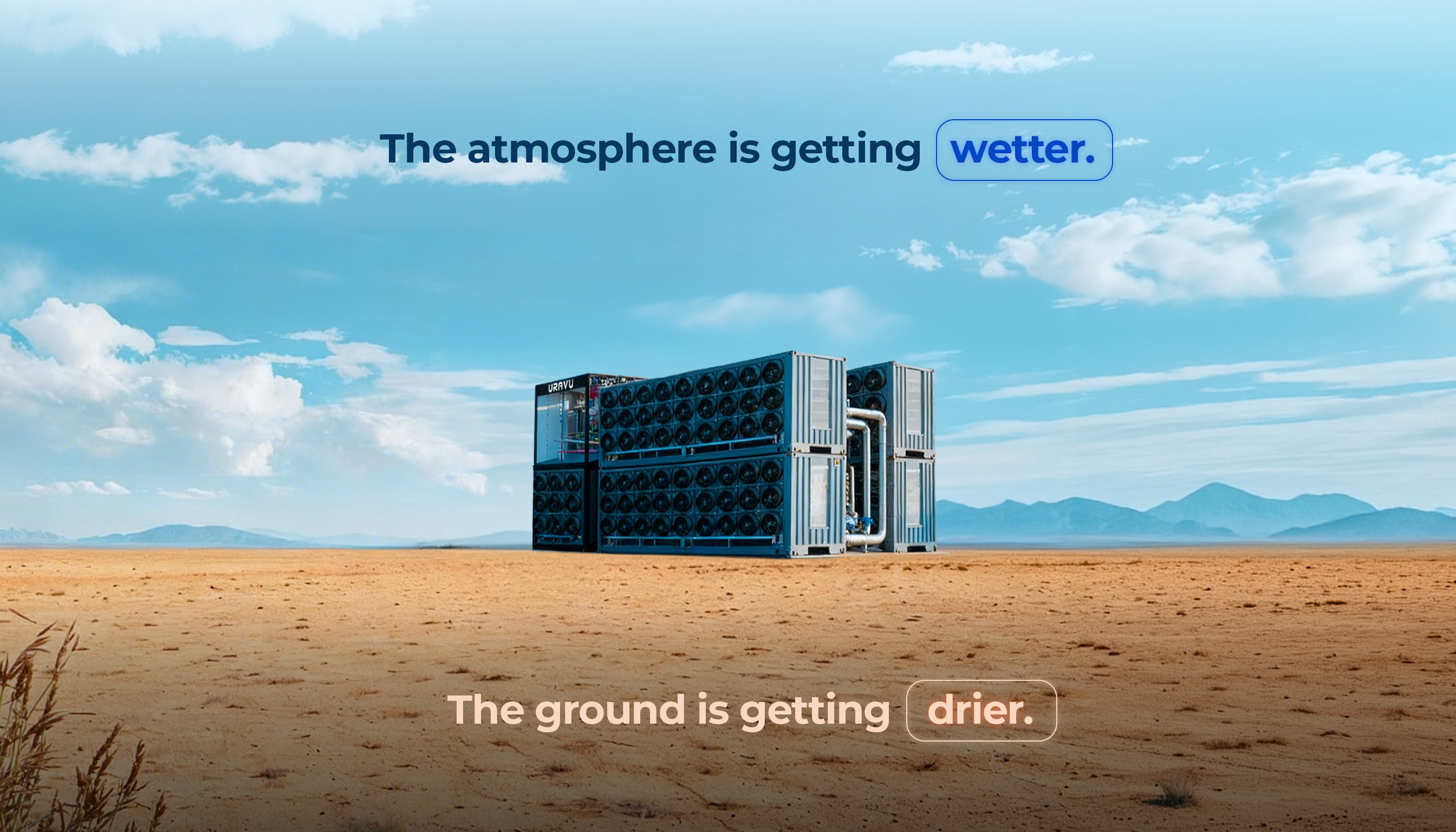
Water vapour in the atmosphere is increasing at approximately 1-2% per decade, in line with the Clausius-Clapeyron relation, which dictates that warmer air holds about 7% more moisture per degree Celsius of warming. The irony is thick: the atmosphere is getting wetter, while the ground beneath our feet is getting drier.[11]
Liquid desiccant AWG technology, as deployed by Uravu, essentially arbitrages this asymmetry. It taps a resource that is growing in abundance,i.e., atmospheric moisture, to offset one that is declining; accessible groundwater and reliable surface water. The atmosphere, rather than being victimised, is being asked to share from its expanding surplus. This is less a heist and more a polite redistribution.[16][17][5]
The thermodynamic cost of atmospheric water generation deserves honest mention. The specific energy consumption for desiccant-based AWG, without energy recovery, is approximately 694 kWh/m³; the enthalpy of vaporisation of water which is significantly higher than seawater reverse osmosis desalination at 3-4 kWh/m³. This is, admittedly, a number that would make any energy engineer wince.[17]
However, Uravu's system is designed to decouple the process from grid electricity by utilising multiple heat sources: solar thermal, biomass, industrial waste heat, and hydropower. The use of waste heat from data centres, for instance, turns a thermodynamic liability into a clever symbiosis like, the data centre needs cooling, the desiccant needs heating, and the atmosphere provides the moisture to make it all work. The water is essentially a byproduct of making a computer slightly less sweaty.[18][2][1]
When powered by renewable or waste energy, the effective carbon footprint and the environmental cost of atmospheric water generation drop substantially, making the technology not just viable but genuinely climate-positive in certain configurations.[16]
A Proportionality Table for the Anxious
The Verdict
The atmosphere is not going to miss the water. It can't, because it will have already replaced it before anyone finishes reading this sentence. With a standing reservoir of 12,900 cubic kilometres, an annual throughput of 495,000 cubic kilometres, and a residence time of just 8-10 days, atmospheric moisture is the most aggressively renewable water source on the planet.[8][6]
But the deeper story is this: the atmosphere doesn't just have enough water to share but it has too much, and the excess is making the planet warmer. Meanwhile, the ground is haemorrhaging freshwater at rates that have doubled since 1960. The great water inversion of the 21st century; sky getting wetter, ground getting drier is one of the most consequential and least discussed symptoms of climate change.
What Uravu Labs is doing is the hydrological equivalent of collecting dew; a practice that dates back to the Inca civilization, who sustained entire communities above the rain line using fog fences. The technological principle is ancient. The liquid desiccant execution is modern. And the atmospheric impact is, in the most rigorous scientific assessment possible: negligible.[19]

The atmosphere, for its part, remains stoically indifferent. It has been evaporating and precipitating 495,000 cubic kilometres of water annually for hundreds of millions of years.
If anything, the atmosphere might appreciate that someone is finally paying attention to it as a water source rather than just complaining about the humidity.
References
1. Innovative air-to-water tech using liquid desiccant makes affordable ... - Bengaluru-based Uravu Labs employs an innovative technology that uses a liquid desiccant to bottle a...
2. 'Harvesting water from air can help reimagine ... - Uravu Labs, a Bengaluru-based deep-tech startup, harvests water from air entirely powered by renewab...
3. Uravu Labs: Creating Drinking Water from Air | MIF Scale-Up - In simple terms, Uravu Lab's technology exposes common desiccant materials like silica and calcium c...
4. Uravu Labs Pvt Ltd - 18startup - Scaling Production: From producing just five litres per day in 2019, Uravu Labs now produces 4,000 l...
5. Uravu Labs Pvt Ltd - Uravu Labs - Renewable Water From Air. Water sustainability for the 21st century.
6. The Water Cycle - NASA Science - The amount of water in the atmosphere at any moment in time is only 12,900 cubic kilometers, a minut...
7. How much water is there in the air? - GENAQ - According to the United States Geological Survey (USGS), the atmosphere contains approximately 12,90...
8. The residence time of water in the atmosphere revisited - HESS
9. The residence time of water vapour in the atmosphere
10. Understanding Water Vapor in Our Atmosphere - Oreate AI Blog - Water vapor comprises approximately 0.4% to 2% of Earth's atmosphere and plays a critical role in we...
12. [PDF] The residence time of water in the atmosphere revisited - HESS - For evaporation they found are sidence time of 8.7 days, with fast ... atmospheric water increases g...
13. ATMOSPHERIC WATER GENERATION: CONCEPTS AND ... - Changes in operating environment conditions have a profound impact on the performance of atmospheric...
14. Guest post: Investigating climate change's 'humidity paradox' - The key reasons for the humidity paradox are two-fold: the Earth is warming and warmer air can hold ...
15. The residence time of water vapour in the atmosphere
16. Harnessing Renewable Energy to Produce Water from Air - Uravu Labs, a Bengaluru-based startup, has developed an atmospheric water generator (AWG) that uses ...
17. [PDF] Techno-economic analysis of atmospheric water generation by ... - Liquid desiccant-based AWG methods show promising performance advantages and offer a versatile appro...
18. Data Centre - Uravu Labs - 1) Drive water generation from air through a liquid desiccant cycle. 2) Thermally cool the coolant l...
19. Atmospheric water generator - An atmospheric water generator (AWG), is a device that extracts water from humid ambient air, produc...